일사계와 태양복사 센서: 차이점은 무엇인가?

소개

With the rapid growth of solar energy systems, accurate solar irradiance measurement has become increasingly important for evaluating photovoltaic (PV) performance, optimizing energy output, and ensuring reliable system operation. In daily monitoring and solar resource assessment, engineers often compare different measurement devices, especially when choosing between a pyranometer vs radiation sensor. Although these two terms are closely related, they represent different levels of solar irradiance measurement technology, with differences in sensing principle, accuracy, and application requirements.

However, these devices are not always identical. They may differ in measurement principles, accuracy levels, response characteristics, and application requirements. Selecting the wrong type of irradiance measurement device can affect the reliability of solar data and the accuracy of PV performance analysis.

This article explains the key differences between pyranometers and solar radiation sensors, including their working principles, measurement characteristics, and typical applications, helping users choose the most suitable solution for PV monitoring and solar radiation measurement.

What Is a Pyranometer?

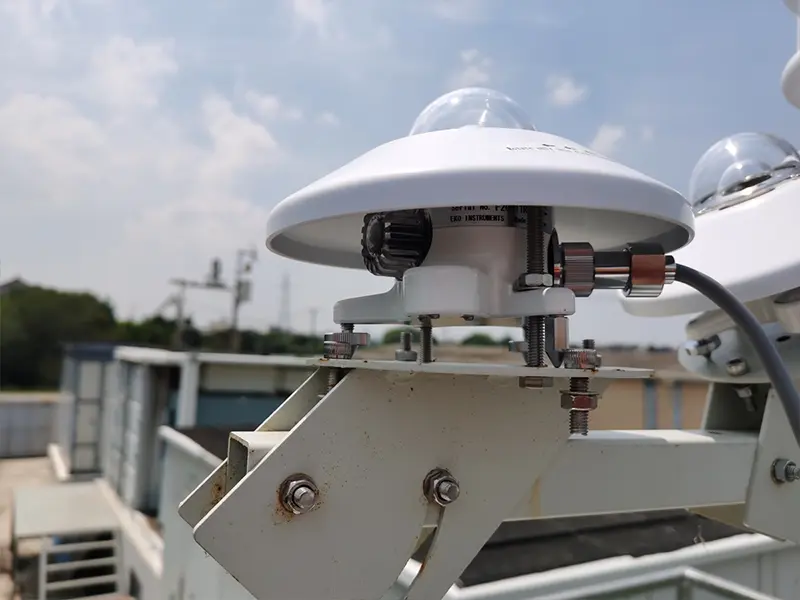
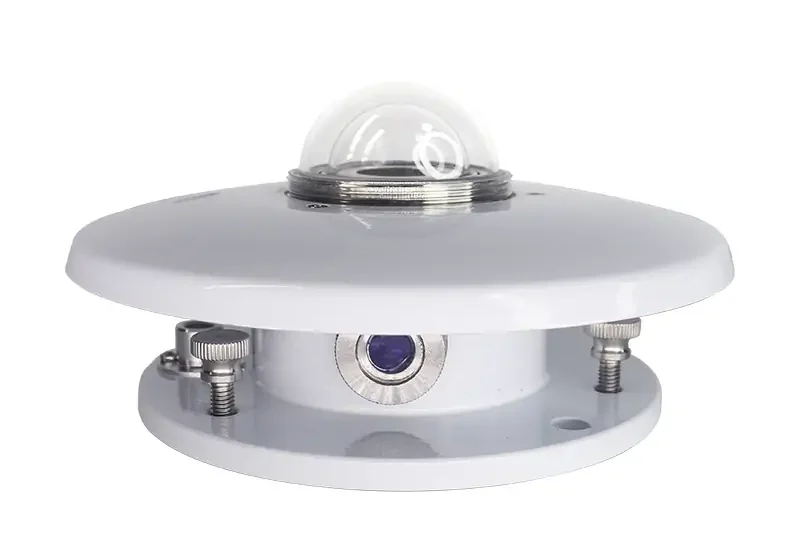
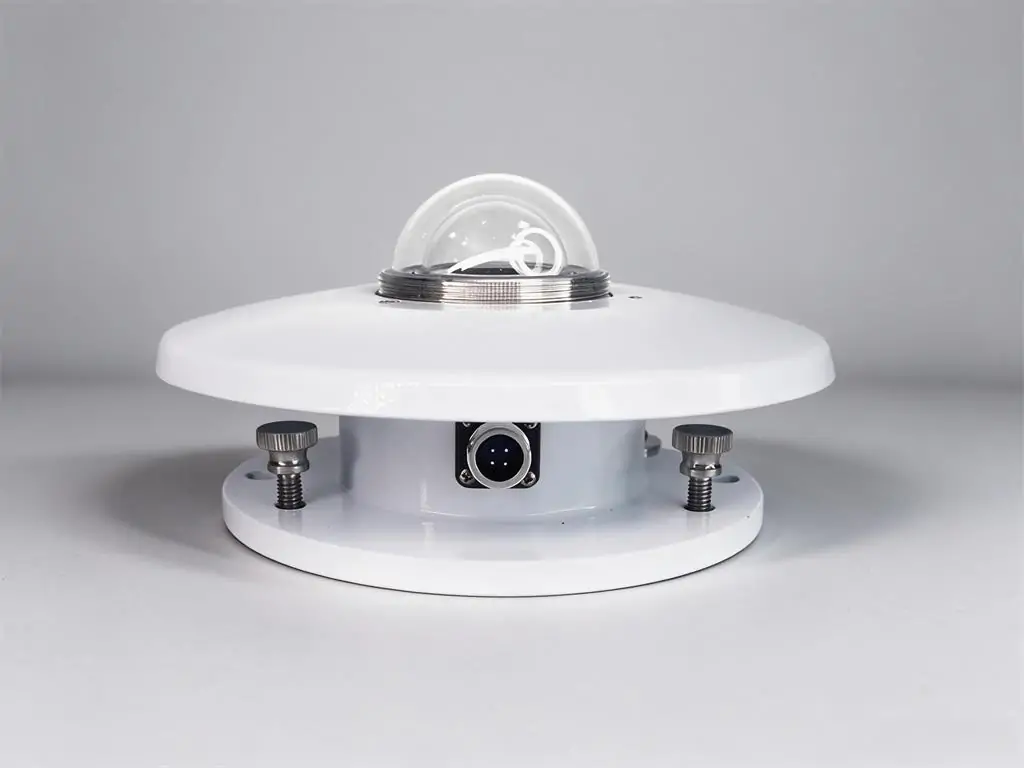
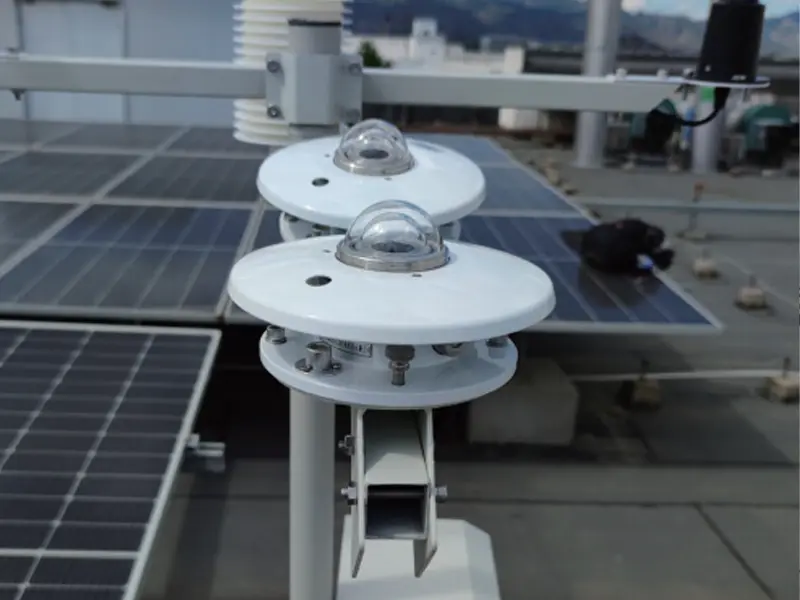
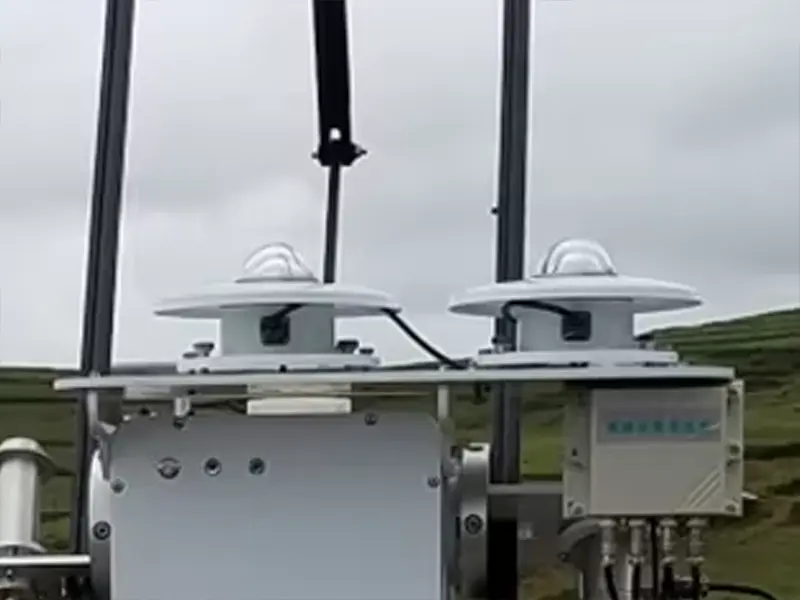
A pyranometer is a precision instrument used to measure solar irradiance, which refers to the solar radiation power received per unit area. The measurement is usually expressed in watts per square meter (W/m²). In solar monitoring applications, pyranometers are mainly used to measure global solar irradiance, including both direct and diffuse radiation, providing accurate data for solar energy analysis and environmental monitoring.

Most pyranometers work based on the thermopile principle. When solar radiation passes through the glass dome and reaches the sensing element, the absorbed energy creates a temperature difference between the hot and cold junctions. This temperature difference is converted into an electrical signal proportional to the incoming irradiance. Professional pyranometers are designed with stable calibration, wide spectral response, and reliable outdoor performance to ensure accurate measurements under changing weather conditions.

Due to their high measurement accuracy and long-term stability, pyranometers are widely used in photovoltaic (PV) performance monitoring, solar resource assessment, meteorological stations, and scientific research. In PV systems, the irradiance data collected by pyranometers helps evaluate solar plant performance, calculate performance ratio (PR), and analyze energy generation efficiency.

What Is a Solar Radiation Sensor?

A solar radiation sensor is a general term for deviwatts per square meter (W/m²), and are widely used in photovoltaic systems, weather monitoring, environmental research, and solar energy applications.

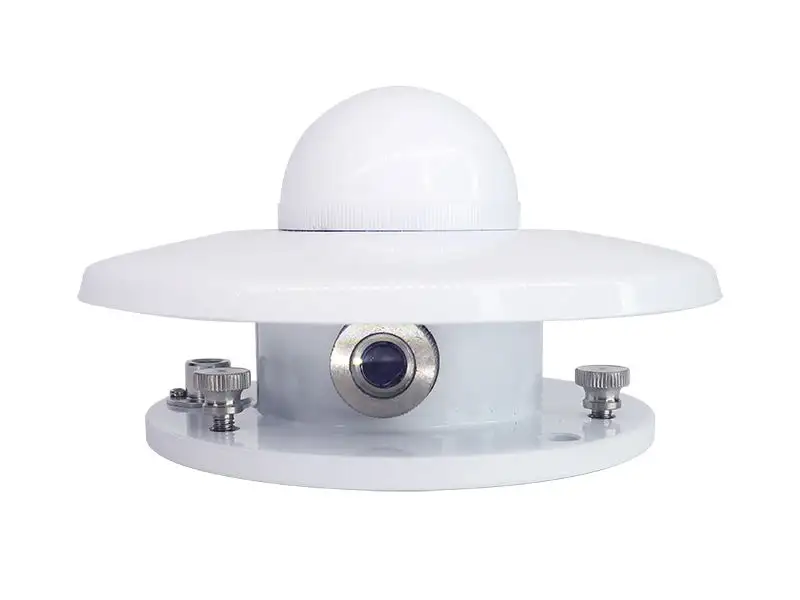
Unlike a pyranometer, which refers to a specific type of high-accuracy solar irradiance measurement instrument, a solar radiation sensor represents a broader category that includes different sensing technologies. Depending on the measurement principle and application requirements, solar radiation sensors may use thermopile, silicon photodiode, or photovoltaic reference cell technologies to collect irradiance data.

Solar radiation sensors are commonly used for PV system monitoring, solar resource assessment, meteorological observation, and environmental monitoring. In photovoltaic applications, they provide real-time irradiance information to evaluate solar conditions, analyze energy production performance, and support system optimization. The selection of a suitable sensor depends on factors such as required accuracy, response speed, installation environment, and monitoring objectives.

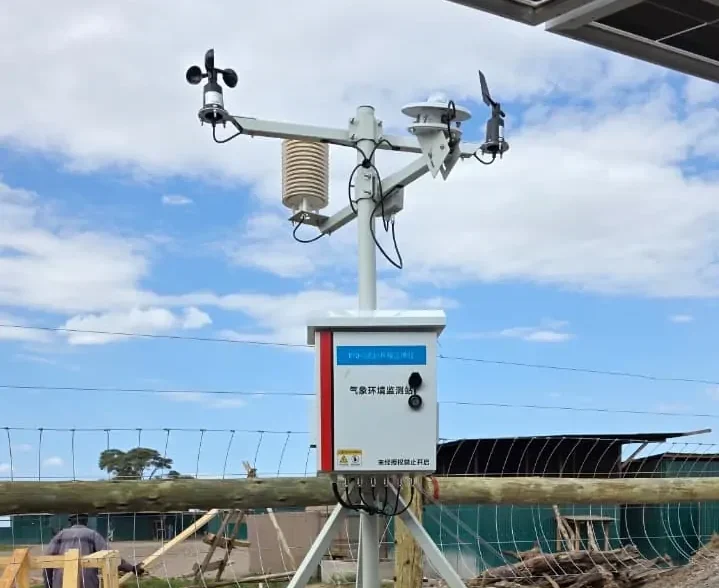
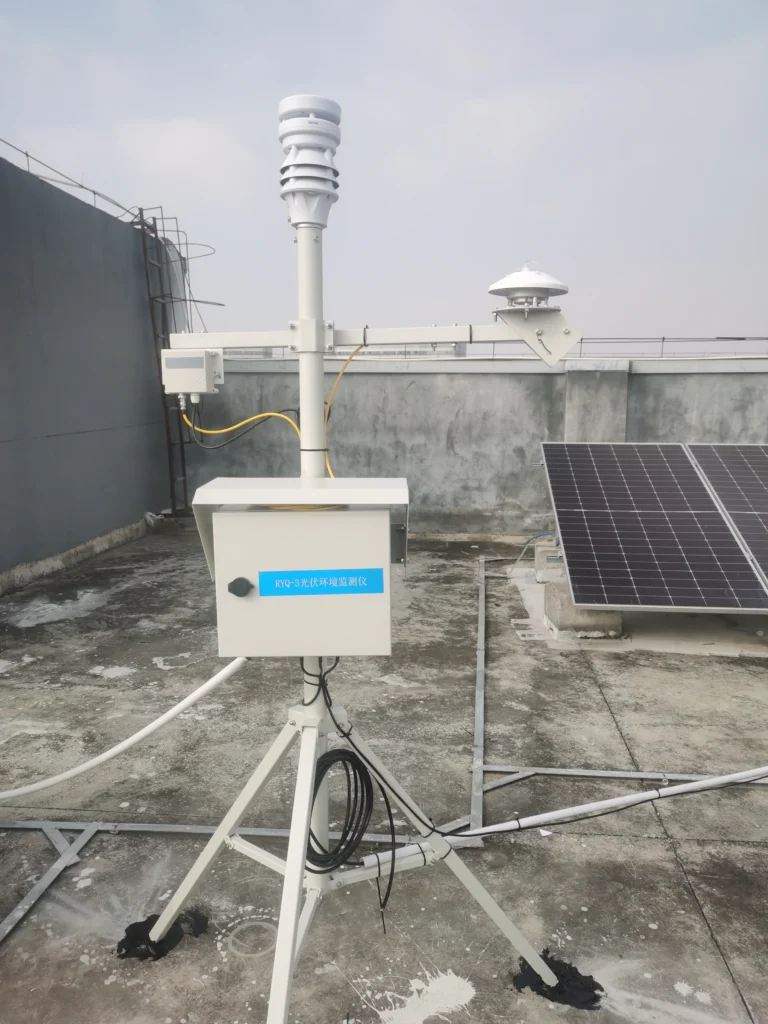
For PV monitoring and solar resource assessment applications, selecting the right irradiance measurement device is essential for obtaining reliable solar data. Solutions such as TBQ-2C Solar Radiation Sensor, 무선 태양 복사 센서, 및 RYQ-3 Solar PV Environmental Monitoring Station provide different options for solar irradiance monitoring, remote data collection, and photovoltaic system evaluation.

Pyranometer vs Solar Radiation Sensor: Main Differences

A pyranometer is a type of solar radiation sensor, but not all solar radiation sensors are pyranometers. The main difference is that a pyranometer is a specialized instrument designed for accurate solar irradiance measurement, while solar radiation sensor refers to a broader category of devices using different sensing technologies.

요인피라노미터태양 복사 센서
정의A precision solar irradiance instrumentA general term for solar radiation measurement devices
카테고리A type of solar radiation sensorA broader sensor category
기술Mainly thermopile-basedThermopile, silicon, or photodiode technologies
측정Solar irradiance (W/m簡)Solar radiation intensity (W/m簡)
정확성Higher accuracyDepends on sensor type
응답 시간보통Faster for some sensor types
비용더 높음More flexible range
애플리케이션PV monitoring, solar assessment, weather stationsPV systems, environmental monitoring, basic irradiance measurement

Pyranometer vs Solar Radiation Sensor for PV Monitoring

Accurate irradiance measurement is a fundamental requirement for photovoltaic (PV) system performance evaluation, because the available solar energy directly determines the theoretical power generation potential of a PV array. Although pyranometers and solar radiation sensors are both used to measure solar irradiance, their measurement accuracy, spectral response, calibration stability, and suitability for different monitoring scenarios can vary considerably.

In a professional PV monitoring system, irradiance data is not analyzed independently. It is typically integrated with module temperature, ambient temperature, wind speed, and other meteorological parameters to assess operating conditions and calculate key performance indicators. The reliability of irradiance measurement directly affects energy yield analysis, system efficiency evaluation, and long-term operational decisions.

Performance Ratio (PR) Calculation

Performance Ratio (PR) is one of the most important parameters for assessing the actual performance of a PV plant. It evaluates how efficiently a solar system converts the available solar resource into electrical energy by comparing the measured energy output with the expected output under the same irradiance conditions.

For accurate PR evaluation, monitoring systems require reliable Plane of Array (POA) irradiance measurements, as the POA value represents the solar radiation actually received by the PV modules at their installation angle. A high-quality pyranometer provides a stable irradiance reference by accurately measuring solar radiation across a broad spectral range, making it suitable for professional PV performance monitoring.

Compared with general solar radiation sensors, thermopile pyranometers typically provide better long-term stability, lower measurement uncertainty, and improved cosine response under changing solar angles. These characteristics make them valuable for applications requiring reliable irradiance data, including PV performance verification, energy yield assessment, degradation analysis, and fault diagnosis.

Selecting the Right Sensor for Different PV Applications

The selection between a pyranometer and other solar radiation sensors should be based on project objectives, required measurement accuracy, and operating conditions rather than cost alone. Different PV applications have different requirements for measurement uncertainty, response speed, and data reliability.

For utility-scale PV power plants, where irradiance data is used for performance benchmarking, contractual reporting, and investment-level analysis, thermopile pyranometers are commonly preferred. Their high accuracy, stable calibration performance, and strong environmental adaptability make them suitable for long-term outdoor monitoring.

For commercial and rooftop PV systems, the monitoring requirements are usually more focused on operational management and cost efficiency. Silicon-based solar radiation sensors can provide practical irradiance monitoring with faster response characteristics and lower system cost, making them suitable for applications where extremely high measurement accuracy is not essential.

For solar resource assessment and meteorological monitoring, professional pyranometers remain a preferred choice because they provide consistent solar radiation data for site evaluation, climate observation, and renewable energy research. Their measurement reliability is particularly important when historical irradiance data is used for solar project feasibility analysis.

Measurement Accuracy Comparison: Pyranometer vs Solar Radiation Sensor

Although a pyranometer is a type of solar radiation sensor, the difference in measurement accuracy mainly comes from calibration level, sensing technology, and environmental compensation capability. General solar radiation sensors can provide irradiance data for basic monitoring, while professional pyranometers are designed for applications requiring lower measurement uncertainty and long-term data reliability.

For PV monitoring, irradiance accuracy directly affects performance ratio (PR) calculation, energy yield assessment, and system performance verification. Therefore, the accuracy requirements of the sensor should be evaluated based on how the measurement data will be used rather than only the initial equipment cost.

Calibration and Measurement Uncertainty

Calibration quality is one of the most important factors affecting irradiance measurement accuracy. Professional pyranometers are typically manufactured and calibrated according to international performance classifications such as ISO 9060, which evaluates key parameters including non-stability, non-linearity, spectral selectivity, temperature response, and directional response.

Compared with general solar radiation sensors, high-class pyranometers provide lower measurement uncertainty and better long-term consistency. This makes them suitable for applications where irradiance data is used as a reference value, such as utility-scale PV performance evaluation, solar resource assessment, and long-term energy yield analysis.

For basic solar monitoring systems, general radiation sensors may provide sufficient accuracy for observing irradiance trends. However, when measurement data is used for financial analysis, contractual performance verification, or detailed PV system diagnosis, higher-accuracy pyranometers are usually preferred.

Environmental Stability: Temperature and Cosine Response

Outdoor solar monitoring equipment must operate under changing environmental conditions, where temperature variations and different solar angles can affect measurement results. A sensor with poor environmental compensation may experience output drift, reducing the reliability of long-term irradiance data.

Professional pyranometers are designed with optimized thermal structures, temperature compensation, and improved cosine response to maintain accurate measurements throughout daily and seasonal changes. Cosine response is particularly important because the sun’s incident angle changes continuously from sunrise to sunset, affecting how radiation reaches the sensor surface.

Compared with general solar radiation sensors, pyranometers usually provide more stable performance under different operating conditions, making them better suited for PV plants requiring accurate Plane of Array (POA) irradiance measurements and reliable performance analysis.

How to Choose Between a Pyranometer and Solar Radiation Sensor?

Selecting between a pyranometer and a solar radiation sensor is not simply about choosing a better device. Since a pyranometer is a specialized type of solar radiation sensor, the right choice depends on the required measurement accuracy, application purpose, installation environment, and system integration requirements.

Define Measurement Purpose

The first step is identifying how the irradiance data will be used. For utility-scale PV performance evaluation, solar resource assessment, and research applications, high-accuracy pyranometers are commonly selected because reliable irradiance data is essential for PR calculation and energy yield analysis. For basic PV monitoring, weather stations, or agricultural applications, other solar radiation sensors may provide a more cost-effective solution.

Consider Accuracy Requirements

Measurement accuracy should match the importance of the collected data. Professional PV monitoring systems often use pyranometers designed according to ISO 9060 performance standards, providing lower measurement uncertainty and better long-term stability. When accurate reference irradiance data is required, such as for performance verification or investment analysis, higher-class pyranometers are preferred. For general monitoring where approximate irradiance trends are sufficient, silicon-based sensors can meet practical requirements.

Check Installation Conditions

Outdoor installation conditions have a direct impact on sensor reliability. Factors such as dust, rain, temperature variations, and long-term solar exposure should be considered during selection. Sensors used in demanding environments should provide appropriate protection, temperature compensation, and stable calibration performance to ensure consistent irradiance measurements throughout the operating period.

Evaluate Communication Interface

For industrial PV monitoring systems, communication capability is also an important selection factor. Interfaces such as RS485, Modbus RTU, and 4–20mA enable direct connection with data loggers, SCADA platforms, and remote monitoring systems. This allows continuous irradiance data collection, centralized analysis, and efficient operation management.

결론

Pyranometer and solar radiation sensor are closely related terms, but they are not interchangeable in every application. A pyranometer is a specialized solar irradiance measurement instrument designed for higher accuracy and long-term stability, while solar radiation sensor refers to a broader category that includes different sensing technologies.

For PV monitoring, weather stations, and solar resource assessment projects, the right sensor selection depends on accuracy requirements, installation conditions, monitoring objectives, and system integration needs. Choosing the appropriate irradiance measurement solution helps improve data reliability, optimize system performance evaluation, and support long-term operational decisions. For complete photovoltaic monitoring requirements, explore our 태양광 발전 산업 솔루션 to learn how integrated solar measurement solutions can support different PV applications.

If you are selecting a solar radiation measurement solution for your PV project or environmental monitoring system, contact our technical team for professional advice on sensor selection, configuration, and system integration based on your specific application requirements.

자주 묻는 질문

No. A pyranometer is a specific type of solar radiation sensor designed for accurate solar irradiance measurement, while solar radiation sensor is a broader category that includes different sensing technologies. Pyranometers are commonly used when high accuracy, long-term stability, and reliable calibration are required, while other radiation sensors may be selected for cost-effective or application-specific monitoring.

The best choice depends on the PV project requirements. Utility-scale solar plants typically use pyranometers because they provide accurate irradiance data for PR calculation, energy yield evaluation, and performance verification. For smaller PV systems or basic monitoring applications, silicon-based solar radiation sensors can provide sufficient data with faster response and lower cost.

Accurate irradiance data is essential for evaluating whether a PV system is operating as expected. Solar irradiance measurements are used for performance ratio (PR) calculation, power generation analysis, and fault diagnosis. Measurement errors from inaccurate sensors can affect energy yield evaluation and make it difficult to identify actual performance issues in photovoltaic systems.

The ISO 9060 standard is commonly used to evaluate pyranometer performance, including factors such as non-stability, non-linearity, temperature response, and spectral characteristics. Higher-class pyranometers provide lower measurement uncertainty and are typically selected for professional applications such as solar resource assessment, meteorological monitoring, and utility-scale PV performance analysis.

Yes, in some applications. A solar radiation sensor can be used for basic irradiance monitoring, operational control, or cost-sensitive PV systems. However, when accurate reference measurements are required for PR evaluation, energy yield analysis, or project verification, a calibrated pyranometer is usually preferred because of its higher stability and measurement reliability.

Calibration frequency depends on sensor type, accuracy requirements, and operating environment. Professional pyranometers used in PV plants or research applications are usually calibrated periodically to maintain measurement reliability. Lower-cost radiation sensors may require less frequent calibration but should still be checked regularly to ensure stable output and accurate irradiance monitoring.

For PV applications, a pyranometer should normally be installed at the same tilt angle and orientation as the solar modules to measure Plane of Array (POA) irradiance accurately. The installation location should avoid shading, dust accumulation, and obstacles that may affect sunlight exposure. Proper leveling and regular maintenance are also important for reliable measurements.

Solar radiation sensors can be connected with data loggers, SCADA platforms, and remote monitoring systems through interfaces such as RS485, Modbus RTU, and 4–20mA outputs. The collected irradiance data can be combined with power generation and environmental information to support PV performance analysis, system management, and long-term operational optimization.

관련 기사