Introduction
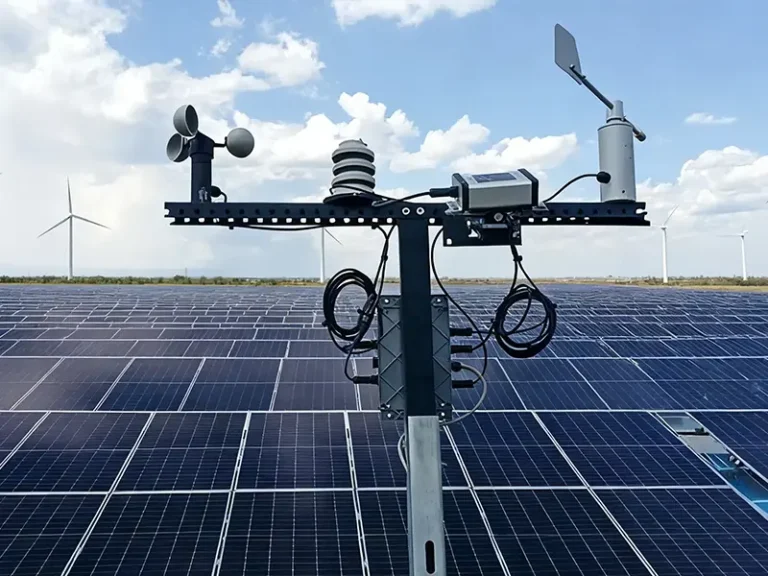
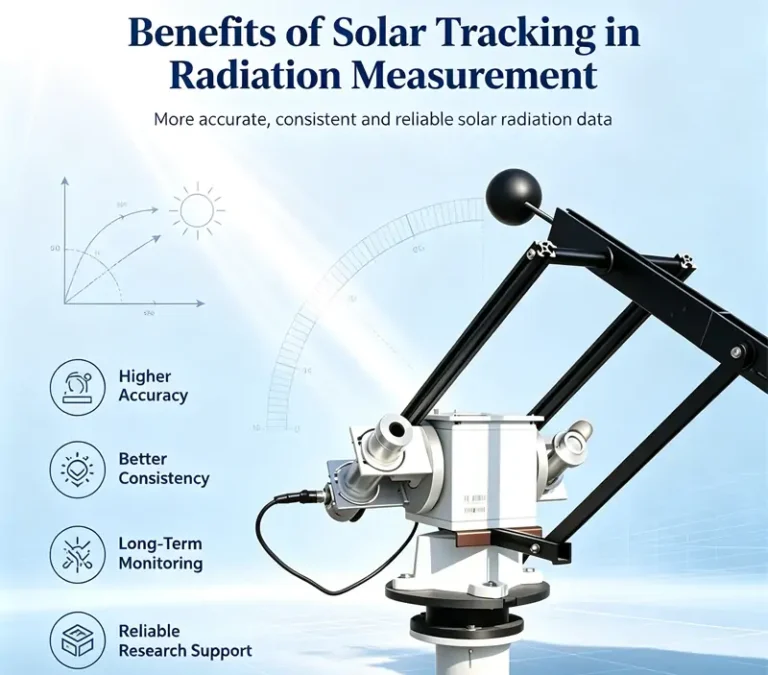
A solar sensor is a precision optical device used to detect the sun’s position and angle of incidence. It is widely applied in systems requiring precise attitude control and light source tracking. Primarily designed to measure angular deviations of sunlight relative to equipment, it provides real-time positional data to control systems, ensuring devices consistently face optimal light reception directions. Common applications include satellite attitude control, solar photovoltaic tracking systems, drone navigation, and meteorological monitoring equipment.
As an indispensable component in the photovoltaic industry, this article will guide you through a detailed understanding of solar sensors, types, uses, working principles, and selection choice. Please continue reading.

How Does a Solar Sensor Work?
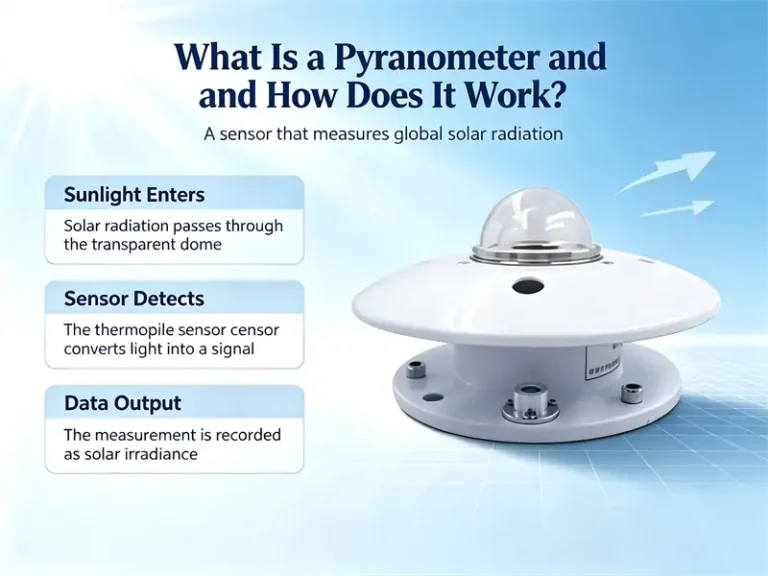
Solar sensors operate by precisely measuring the angle of solar incidence and radiation intensity through mechanisms such as the photoelectric effect, thermopiles, or photodiodes. They provide core data for systems including attitude control, photovoltaic tracking, and meteorological monitoring. Different measurement principles offer distinct advantages in accuracy, response speed, and environmental adaptability, allowing flexible selection based on application requirements.
For output, solar sensors provide both analog signals (0–5V / 4–20mA) and digital signals (RS485 / Modbus, SDI-12). This versatility accommodates diverse integration needs in industrial control, remote data transmission, and low-power monitoring, enabling stable and reliable real-time monitoring and control.
What is Solar Radiation? Complete Guide to Measurement & Monitoring
Types of Solar Sensors
Solar sensors can be categorized into various types based on their measurement principles and application scenarios, each exhibiting distinct characteristics in terms of accuracy, response speed, cost, and system compatibility. Understanding these types facilitates selecting the most suitable sensor for specific requirements, thereby enabling efficient solar radiation monitoring and optimized control of photovoltaic systems. Below are several common types of solar sensors.
Photosynthetic Active Radiation Sensor
The Photosynthetic Active Radiation Sensor (PAR) measures the intensity of photosynthetically active radiation within the 400–700 nm wavelength range of natural light. Utilizing a silicon photodetector and optical filter, the sensor outputs a voltage signal proportional to incident light intensity, with sensitivity proportional to the cosine of the incident light angle (unit: μmol/m²·s). With a simple structure, it can be directly connected to a digital meter or data logger. Suitable for all weather conditions, it is widely used in agricultural meteorological observation and crop growth research.
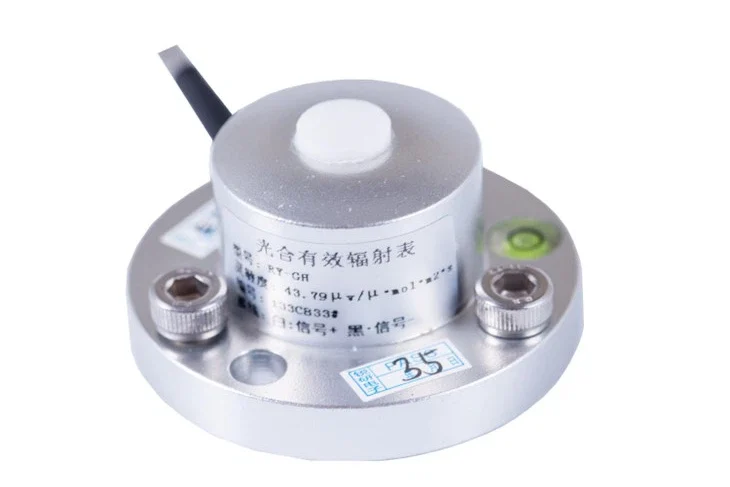
| Parameter | Specification |
|---|---|
| Spectral Range | 400–700 nm |
| Sensitivity | 7–70 μV / μ·mol·m²·s |
| Response Time | <1 s (99% response) |
| Temperature Dependence | Max 0.05% / ℃ |
| Cosine Correction | Up to 80° incident angle |
| Internal Resistance | <2 kΩ |
| Working Environment | Temperature -40–65 ℃, Humidity <90% |
| Output | 200 mV original output |
| Range | 0–4000 μ·mol·m²·s |
| Wiring (Voltage Type) | Red + White – |
| Wiring (Current Type) | Red + Black-Yellow (4–20 mA) |
| Wiring (RS485 Type) | Red + Black-Yellow, Blue B |
| Standard Wiring Length | 1.5 m |
| Maximum Lead Length | Current: 200 m, RS485: 100 m, Voltage: 50 m |
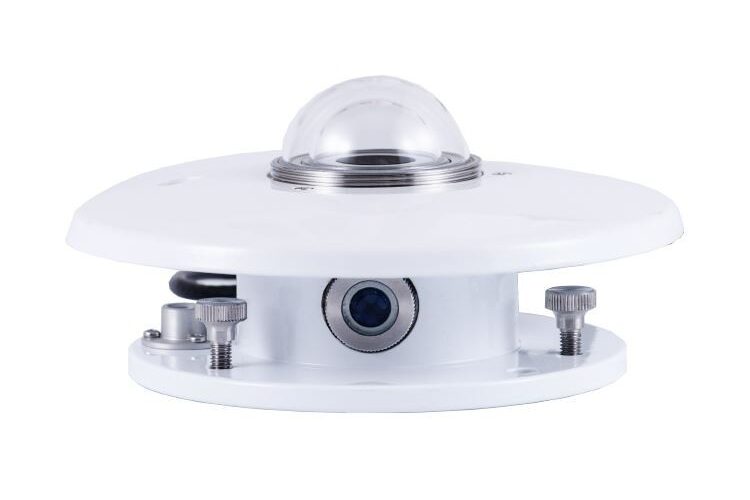
TBQ-2C Total Radiation Meter
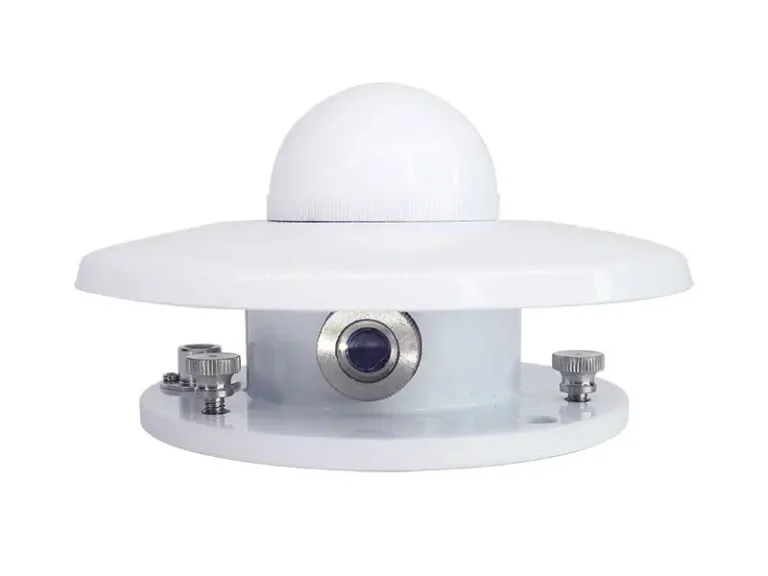
The TBQ-2C Total Radiation Meter measures total solar radiation in the 0.3–3.2 micrometer wavelength range. Its core component is a fast-response wire-wound thermopile coated with 3M matte black paint. It generates a thermoelectric voltage output proportional to solar radiation intensity through temperature differences. The double-layer quartz glass design minimizes air convection effects and blocks external infrared radiation, ensuring high-precision measurements suitable for meteorological monitoring and solar energy research.
Specifications
| Parameter | Specification |
|---|---|
| Sensitivity | 7–14 mV/kW·m² |
| Response Time | <35 s (99% response) |
| Annual Stability | ≤ ±2% |
| Cosine Response | ≤ ±7% (solar elevation 10°) |
| Position Error | ≤ ±5% (solar elevation 10°) |
| Non-linearity | ≤ ±2% |
| Spectral Range | 0.3–3.2 μm |
| Temperature Coefficient | ≤ ±2% (-10–40 ℃) |
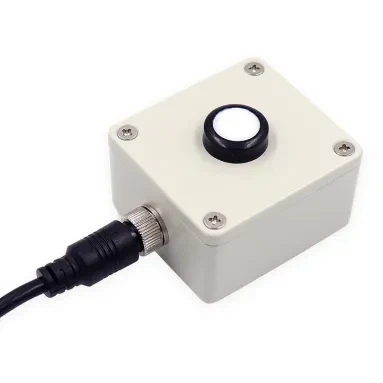
RY-CZW RS/485 Ultraviolet Radiation Sensor
RY-CZW RS/485 Ultraviolet Radiation Sensor precisely measures atmospheric solar ultraviolet radiation (UVAB band). It provides UV index, sunburn dose, and information on ultraviolet effects on human health and ecosystems via data loggers. This instrument is widely used for ultraviolet radiation monitoring, environmental and ecological impact studies, climate change analysis, and UV forecasting, delivering reliable data for scientific research and public health.
| Product Name | Ultraviolet radiation sensor |
| Spectral Range | UVAB 280~400nm |
| Cosine Response | ≤4%(When the solar altitude angle is 30 degrees) |
| Working Temperature | -50℃~+50℃ |
| Measuring Range | 0~70 w/m-2 / UV index 0-15 |
| Response Time | ≤1s(99% response) |
| Output | RS485 |
Applications of Solar Sensors
Solar sensors precisely measure solar radiation intensity and incident angle, providing real-time data support for diverse systems. Their applications span meteorological monitoring, photovoltaic energy management, agricultural environmental control, and smart building and urban management. These sensors enhance system efficiency, optimize resource utilization, and enable automated control.
Weather Stations
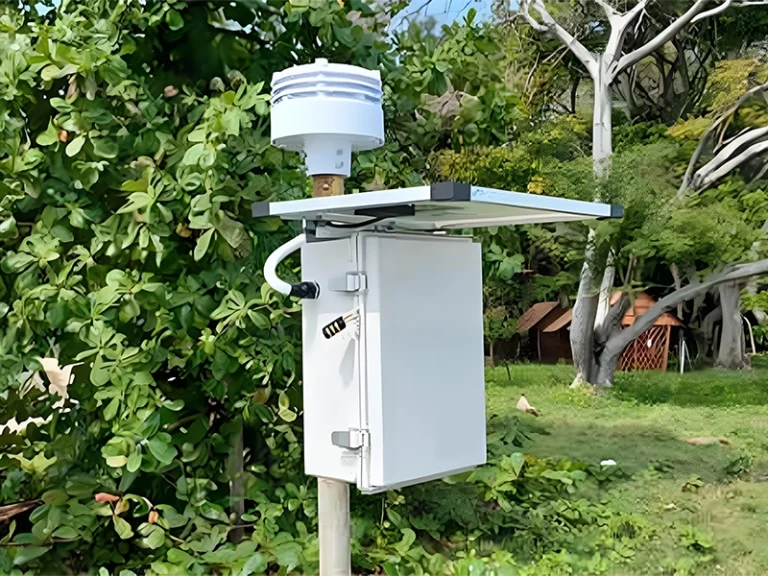
Within meteorological observation stations, solar sensors measure solar radiation intensity and UV index, delivering high-precision data for weather forecasting, climate research, and environmental monitoring. This supports weather modeling and long-term climate analysis.
Solar PV Monitoring Systems
Solar PV monitoring systems utilize solar sensors to track the sun’s position and radiation intensity in real time, enabling optimal angle adjustment of solar panels to enhance photovoltaic power generation efficiency. They also monitor system performance and facilitate fault diagnosis.
Agricultural Climate Monitoring
In agricultural climate monitoring, solar sensors measure photosynthetically active radiation (PAR), providing precise light data for crop growth research, greenhouse environmental control, and agricultural meteorological services. This promotes efficient crop growth and yield optimization.
Building Automation & Smart Cities
In smart buildings and cities, solar sensors enable light monitoring, intelligent lighting control, and energy management. By leveraging real-time data, they optimize building energy usage, regulate indoor lighting environments, and monitor urban conditions, driving green and low-carbon development.
Solar Sensor vs Pyranometer: What’s the Difference?
Both solar sensors and pyranometers are key instruments for measuring solar radiation, but they differ significantly in design principles, accuracy, application scope, and cost. Solar sensors are typically budget-friendly with fast response times, making them suitable for photovoltaic tracking, smart control systems, and real-time monitoring. Pyranometers, on the other hand, are professional-grade measurement devices offering high precision and stability. They comply with international standards like ISO 9060 and are ideal for scientific research, meteorology, and high-accuracy radiation assessment. The comparison table below summarizes their main differences.
| Feature | Solar Sensor | Pyranometer |
|---|---|---|
| Type | Economical / Industrial use | Professional / Research grade |
| Accuracy | Moderate, suitable for real-time monitoring | High precision, long-term stability |
| Response Time | Fast (milliseconds to seconds) | Slower (seconds to tens of seconds) |
| Measurement Scope | Direct sunlight / Light intensity | Total solar radiation (direct + diffuse) |
| Output | Analog signal, RS485, 4–20 mA | Analog signal (mV/W·m²) |
| Certification Standard | No mandatory standard | ISO 9060 certified |
| Cost | Lower | Higher |
How to Choose the Right Solar Sensor
When selecting a solar sensor, consider the application scenario, budget, accuracy requirements, and communication method. For photovoltaic systems or building automation, economical sensors with fast response times are suitable. Research or meteorological monitoring, however, requires high-precision, professional-grade equipment. Budget determines available features and accuracy levels; higher budgets allow selection of models with superior long-term stability. Choose accuracy and response speed based on actual requirements while confirming communication protocols (analog signal, RS485, SDI-12, or 4–20 mA) to ensure compatibility with existing systems and reliable data transmission.